K-magpie › Magpie Tests
Magpie Tests 🐦⬛
These are not questionnaires. You enter one thing — your birth date — and a real Korean almanac engine converts it into the eight characters of your saju, then runs those characters through the world you picked. It takes 30 seconds, and because nothing is random, the same birthday returns the same result forever. Which is exactly why they're worth comparing with your friends.

The Azure Dragon, White Tiger, Vermilion Bird and Black Tortoise of the four directions — plus the nine-tailed fox, the haetae, and the divine magpie you may turn out to be yourself. 12 guardians, and how many generations yours has stood watch.

Main vocal, the rapper, the visual, the stage-destroying center — or the agency CEO who ends up on the judging panel instead. 12 positions and your final rank in the survival show.

From a khan of the steppe to the temple cat worshipped as a god in Egypt — 12 past lives, plus which reincarnation you're currently on. How old is your soul?

From the architect who raises the barricade to Zombie No. 1 himself — 12 roles and your survival rate. What percentile does that put you in?

Everyone's hero, the guild receptionist, and the demon lord who somehow outdraws the protagonist. Includes the member count of your isekai fan club.

From the Secret Royal Inspector flashing his horse tally to the storyteller of the market square — 12 occupations and a success index, with your annual stipend in sacks of rice converted to a modern salary.
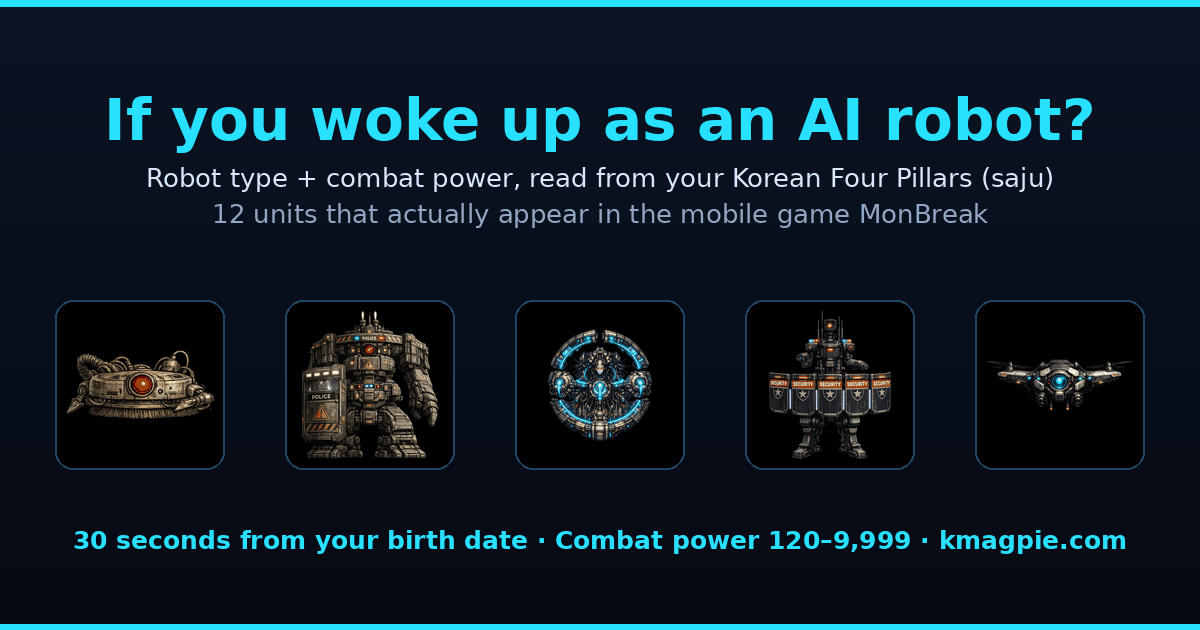
From the barrier generator to MOTHER, the final boss — 12 machines that actually appear in the mobile game MonBreak, each with a combat rating. Which one would you wake up as?
Magpie Tests are not personality quizzes built on answer sheets. They sit on top of a manse-ryeok calculation — the Korean almanac tradition of transcribing a date into the sexagenary cycle of sixty stem-branch pairs. All seven tests share one engine but run different formulas on top of it, so a single person can take all seven and get seven numbers that disagree with each other. There is no randomness anywhere, so the same birthday always returns the same result.
A test with no questions
The personality tests you usually see hand you 12–16 questions, then combine your answers into a type. Change an answer and the result changes; if you know which outcome you want, you can steer toward it. Magpie Tests don't work that way. The only thing asked is your birth date, which is rewritten in the notation of an old calendar system, and the eight characters that come out are dropped into the world you chose.
That means the result can't be gamed. If there's a role you want, you won't get it unless you were born on a different day. What you get instead is something easier to line up next to your friends' results: different birthdays mean the answers came from genuinely different inputs, and two people born on the same day really do land on the same result.
The eight characters themselves aren't a prophecy — they're calendar data. Traditional East Asian calendars label each day with a stem-branch pair the way a Western calendar labels weekdays; your chart is simply the year, month, day and hour of your birth transcribed into four such pairs. What those characters mean is a separate question, and Magpie Tests answer it with world-building rather than fortune-telling.
What makes the seven tests different
All seven are built on the ten possible day masters — the heavenly stem of the day you were born — plus two special conditions that expand the outcomes to twelve. What differs is which energies each world rewards. There's no reason the trait that keeps you alive in a zombie outbreak should be the same one that gets you promoted in a Joseon government office.
| Test | Number it gives you | Two special outcomes | What this world rewards |
|---|---|---|---|
| Zombie outbreak | Survival rate 1–99% | Goe-gang day pillar · Zombie No. 1 | Endurance (in-seong, bi-geop) |
| Isekai | Popularity 1–99% Fan club members | Demon Lord · Legendary Mastermind | Visible charm (sik-sang) |
| Joseon Dynasty | Success index 1–99 Annual stipend in rice | Secret Royal Inspector · Chief State Councillor | Energy that leads to office (gwan-seong) |
| Past life | Reincarnation no. 3–99 Soul-age percentile | Great Khan of the Steppe · Cat of an Egyptian Temple | Memory carried over (in-seong) |
| Idol | Final debut rank 1–99 Contestant percentile | Stage-Destroying Center · The Agency CEO | Raw showmanship (sik-sang) |
| Guardian spirit | Guarded for 3–99 generations Bond-depth percentile | Three-Legged Crow · Divine Magpie | Sheltering energy (in-seong) |
| AI robot | Combat power 120–9,999 Threat grade | Goe-gang unit · MOTHER | Forward drive (bi-geop, sik-sang) |
Take all seven and the difference shows. A high zombie survival rate can sit next to a low Joseon success index, and the reverse is just as common. Neither is the "good" result — it means the worlds ask for different temperaments.
How each test maps the ten day masters onto its roles, and which constants it uses to compute its number, is written out in full on each test's own page.
One engine, different numbers
All seven tests run the same calculation engine as the Korean-language manse-ryeok calculator (in Korean). The year pillar turns over not on January 1 and not on Lunar New Year, but at the exact moment of ipchun, the solar term that begins spring; the month pillar turns over at each of the twelve solar terms. These are timestamps, not dates — ipchun in 2026 falls at 5:02 a.m. on February 4 — so two people born on the same February 4 can end up with different year pillars. The day pillar comes from the Julian Day Number modulo 60.
The reason one engine doesn't produce seven identical answers is that each test carries its own base values and weights. They're tuned so that feeding one birthday into all seven produces coincidentally similar numbers less than 5% of the time — it's simply more fun when the results argue with each other.
The "top N%" badge on each result isn't an estimate. Every one of the 22,280 days from January 1, 1950 to December 31, 2010 was computed in advance, and the resulting distribution table ships inside the page. Your value is looked up against that table.
Your birth date never leaves your browser
The birth date you type is never sent to a server. The entire computation finishes inside your browser, and nothing is stored. There is no sign-up, and nothing is withheld behind an email box.
The same holds when you copy a result link to share it. The link carries only the finished result values — never your birth date. Two people with different birthdays who land on the same result get byte-identical links. Whoever opens your link sees the result with every input field left empty.
The shareable result card image is drawn inside your browser and downloaded from there. It is never uploaded anywhere.
Questions people ask
Do I need a Korean birth date or lunar calendar date?
No. Enter your Gregorian (solar) date — the one on your passport. If you only know a lunar-calendar birthday, convert it first with the lunar-to-solar converter (in Korean) and enter the converted date.
What if I don't know my birth time?
Leave it blank. The test then computes with six characters instead of eight, dropping the hour pillar. Year, month and day pillars are fixed without a time, so the backbone of the result is unchanged — the numbers shift slightly, and if you were born around 11 p.m. or on the day a solar term begins, the role itself can change with the time.
Another saju app gives me a different day pillar
Usually it's a difference in standard-time correction and the late-Rat-hour convention. Korea's clock runs on the 135°E meridian, roughly 30 minutes ahead of true local solar time, and schools of practice disagree about correcting for it. The manse-ryeok calculator (in Korean) explains both conventions and lets you toggle them.
Is any of this a real fortune reading?
The calculation is real; the interpretation is a game. Nothing here predicts your future, and no result carries any claim about your life. If you want the eight characters themselves taken seriously, that's what the tools linked above are for.
I don't like my result
None of the seven tests has a losing outcome. A low survival rate comes attached to a different talent, and the roles that look like defeats — Patient Zero, the Demon Lord — are deliberately the rarest ones to draw. If a number came out low, the interesting move is to see what the other worlds say about you.
Will there be more tests?
Yes, they're still being added. New ones appear at the top of this page.
If you want the serious reading
Magpie Tests compute honestly and interpret playfully. If you're curious about the eight characters themselves, the manse-ryeok calculator (in Korean) shows the full chart with solar terms applied to the minute, and the deeper interpretation of what those characters mean is handled on the sister site Yaong Myeongri (in Korean).